


American Backed Coups

Updated: Jul 22
The Evil Empire At Work - Through Johnny Harris
Resources:
American-Backed Coups, Mapped – The US perfected the art of the coup to push out leaders it didn’t like and install leaders it did. In this story I go through some of the major US-led coups to explore how the US rose to power and stayed there – The Evil Empire At Work
In this eye-opening video Harris delves into the troubling history of U.S. involvement in overthrowing foreign governments, particularly during the Cold War era. The video provides a comprehensive overview of the coups that the U.S. government supported or orchestrated, highlighting the far-reaching consequences of these actions. Harris describes his criteria for the mentioned coups; firstly they must’ve been successful (there’s dozens of other failed coups), there must be at least a few US government officials directly involved and there must be concrete evidence the US govt was actually involved, not just speculation, “While the US has been involved in tons of regime changes around the world, we landed on a much shorter list, these are the coups that best exemplify how this tool has been used for international power over the years” – and the number of countries involved even with this stringent criteria is mind-boggling: Cuba, Dominican Republic, Puerto Rico, Guatemala, Honduras, Nicaragua, Brazil, Chile, Libya, Chad, Congo, Iraq, Iran, Afghanistan, Hawaii, Vietnam, Philippines.
Harris begins by discussing the concept of a coup d'état, which involves the sudden and illegal seizure of power from a government and then introduces the map that serves as the visual centerpiece of the video, showcasing the countries where American-backed coups have taken place; through detailed mapping and historical analysis, Harris highlights the geopolitical motives and consequences of these interventions, providing a comprehensive overview of America's covert operations to influence foreign governments. He sets the stage with a historical context of American-backed coups, explaining how these interventions have been a significant aspect of U.S. foreign policy since World War II, emphasizing that these actions are driven by a desire to promote U.S. interests abroad, often at the expense of local sovereignty and stability.
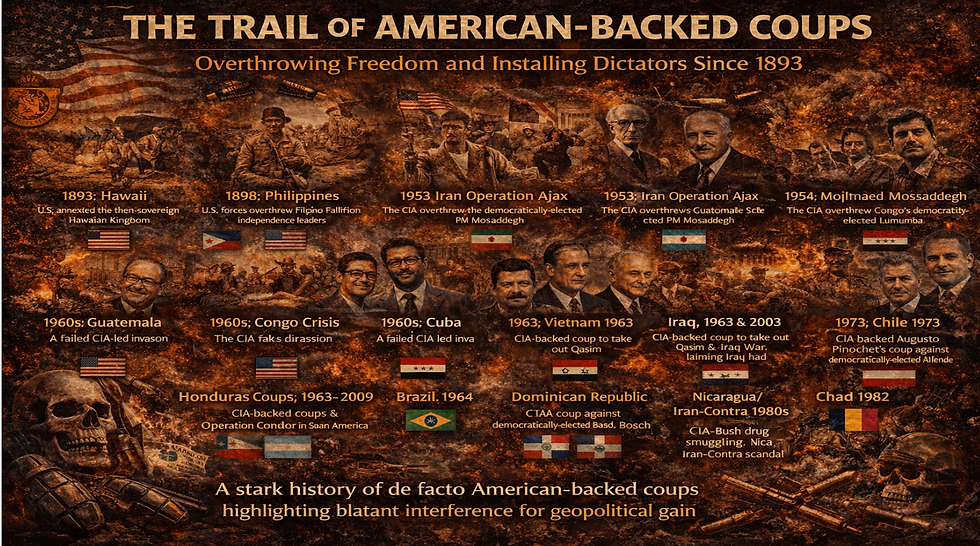
The video proceeds to explore several notable examples of U.S.-backed coups, starting with Hawaii in 1893. Led by American businessmen and plantation owners, the U.S. military supported the overthrow of Queen Liliuokalani, leading to the annexation of Hawaii. Next the Philippines in 1898; following the Spanish-American War, the U.S. suppressed Filipino independence movements, establishing control over the archipelago as the U.S. supported the overthrow of Spanish colonial rule and subsequently fought a war to suppress Philippine independence, leading to American colonization of the islands.
He then leaps into the 1950s with the 1953 coup in Iran AKA Operation Ajax. Harris explains how the democratically elected Prime Minister Mohammad Mosaddegh was overthrown by the CIA and British intelligence, leading to the installation of the Shah, a U.S.-friendly dictator which set the stage for decades of political instability and anti-American sentiment in the region; The coup was driven by Mossadegh's move to nationalize Iran's oil industry, which threatened Western oil interests. Harris illustrates how this intervention set a precedent for future U.S. actions in other countries. He then discusses the 1954 coup in Guatemala, where the CIA orchestrated the removal of President Jacobo Árbenz. Árbenz's land reforms, which affected the interests of the United Fruit Company, prompted the U.S. to intervene under the pretext of combating communism – a coup that led to decades of political instability, violence, civil war and human rights abuses in Guatemala. He touches on Puerto Rico in the 1950s, where the U.S. suppressed a nationalist uprising, maintaining control over the territory.
Moving to the 1960s, Harris covers the Congo crisis, where the CIA played a role in the assassination of democratically elected Prime Minister Patrice Lumumba (no, not by Jason Bourne) and supported the rise of Mobutu Sese Seko. This intervention aimed to counter Soviet influence in Africa but resulted in long-term authoritarian rule and economic decline in the Congo. And then onto Cuba… a coup so significant in shaping the geopolitics of the world in the early 60s that Harris had to include it despite not meeting his criteria of a successful coup. The failed Bay of Pigs invasion alongside Operation Mongoose aimed to overthrow Fidel Castro's communist government and destabilize the regime but instead solidified his rule. We stay in Central America with the Dominican Republic (1961 and 1965) where the CIA supported the assassination of dictator Rafael Trujillo, leading to years of political instability in ‘61 and then U.S. intervention supported a coup to prevent the return of leftist President Juan Bosch in ‘65, leading to the establishment of a pro-American government. Then in Vietnam (1963) the U.S. supported a coup that led to the assassination of President Ngo Dinh Diem, escalating American involvement in Vietnam… one of the few coups the US had to pay the price for as they became locked in the infamous war for another decade thereafter. In 1963 in Iraq, the U.S. supported the Baathist coup that overthrew the government of Abd al-Karim Qasim (bonus points for the 2003 coup in which the U.S. led an invasion to overthrow Saddam Hussein, citing weapons of mass destruction and links to terrorism, resulting in long-term conflict and instability). Then in Brazil in ‘64 the U.S. supported a military coup that overthrew President João Goulart, fearing his leftist policies and instead installed a right-wing dictatorship. In 1963 Honduras the U.S. supported a military coup that ousted democratically elected President Ramón Villeda Morales (and again in 2009 Honduras, the US ousted President Manuel Zelaya, who had moved towards leftist policies).
Finally we move into the 70s in 1973 Chile which outed the democratically elected socialist President Salvador Allende and installed the brutal military dictator Augusto Pinochet, a particularly malevolent bloke whose regime tortured, killed and disappeared 3,065 people in the name of fighting communism. One of the most infamous is the decade-long coup in the 80s in Nicaragua in which the U.S. funded and trained the Contras, a right wing rebel group to overthrow the leftist Sandinista government led by Daniel Ortega. In Chad (1982) the U.S. supported Hissène Habré's coup against President Goukouni Oueddei, leading to yet another brutal dictatorship. Things continued to get cheeky in the Middle East as the U.S. funded and armed the mujahideen rebels (Afghanistan 1979-1989) to fight against the Soviet-backed government, contributing to the rise of the Taliban and then the US sought to destroy their own product in 2001 when they invaded to overthrow the Taliban regime following the September 11 attacks, leading to the notoriously prolonged conflict – everyone knows about the ‘war on terror’ in recent decades, but not many understand that the US was responsible for overthrowing the previous regime that allowed for the Taliban to come to power. Finally in Libya (2011) NATO intervention, with significant U.S. involvement, contributed to the overthrow and death of Muammar Gaddafi, leading to ongoing instability. Harris also touches on Operation Condor in South America, where the U.S. supported right-wing dictatorships to counter leftist movements, resulting in widespread repression, torture, and extrajudicial killings across the continent, “this collaboration had a devastating impact on countries like Argentina, where Condor exacerbated existing political violence and contributed to the "Dirty War" that left an estimated 30,000 people dead or disappeared. Others estimate the toll at 50,000 killed, 30,000 disappeared, and 400,000 imprisoned”.
Throughout the video, Harris emphasizes the pattern of the U.S. government supporting coups against democratically elected leaders who were perceived as threats to American interests, often due to their leftist or socialist leanings, arguing that these actions were driven by a combination of anti-communist ideology and the desire to protect American corporate interests abroad. The video also highlights the hypocrisy of the U.S. government's actions, as it frequently espoused the virtues of democracy and freedom while actively undermining democratic governments in other countries – Harris points out that many of these coups led to the installation of brutal dictatorships and political instability, littered with horrific human rights abuses and long-term resentment towards the United States. Harris calls for greater transparency and accountability in U.S. actions abroad, advocating for a foreign policy that prioritizes stability, democracy, and respect for sovereignty as the video serves as a reminder of the unintended consequences of foreign meddling and the importance of critically examining the actions of one's own government. The video underscores the complexities and ethical dilemmas of U.S. foreign policy; these coups were superficially justified as necessary to combat communism, terrorism or protect American interests while causing significant human and political costs. The destabilization, authoritarianism, and anti-American sentiment resulting from these interventions highlight the need for a more principled and transparent approach to foreign policy. Harris's call for accountability and learning from past mistakes is particularly compelling. He encourages viewers to critically reflect on the legacy of American interventions and consider how future policies can align more closely with democratic values and international stability. Harris's thorough research and engaging presentation make this video an essential resource for understanding the complexities of U.S. interventions and their global impact.
These examples of American-backed coups reveal a disturbing pattern of the United States acting as an "Evil Empire," prioritizing its own economic and strategic interests over the democratic will and well-being of people in other nations. While the U.S. government often justified these interventions under the guise of fighting communism or terrorism, the reality is that many of these coups were driven by a desire to protect American corporate profits and maintain U.S. hegemony in various regions of the world. By overthrowing democratically elected leaders and supporting brutal dictatorships, the U.S. has contributed to countless human rights abuses, political instability, and economic hardship in these countries. The hypocrisy of the U.S. government's actions is striking, as it has repeatedly violated the very principles of democracy and self-determination that it claims to uphold. These coups demonstrate that the U.S. has often prioritized short-term economic gains and geopolitical control over the long-term stability and prosperity of other nations. The legacy of these interventions continues to haunt many of these countries, as they struggle with the aftermath of dictatorships, civil wars, and economic exploitation. Ultimately, the history of American-backed coups paints a picture of a nation that has repeatedly used its military and economic might to shape the world in its own image, often at the expense of the freedom and well-being of people in other countries. It is a sobering reminder of the dark side of American foreign policy and the need for greater accountability and respect for international law.


Comments